09 January 2012
Resident Focused Garden Projects
08 January 2012
Frittrasses: January 3, 2012
The recipe actually comes from a book called Plenty by Yotam Ottolenghi, an accomplished vegetable-oriented chef in London. The title of Ottolenghi's recipe is "Leek Fritters", but I've changed the recipe's name to "Fritrasses" instead. Happy new year, Second Grade!
Who, among you, likes to invent things? Who feels like they’re always full of great ideas for solving problems in creative ways? Well, I’m proud to say that I consider myself a beetle of big ideas and full creativity. Not only that, but as you might have guessed, I have a big heart as well.
Let me share with you one of the inventions I am most proud of: Frittrasses! You see, dear Second Grade, as you remember I’m sure, I used to work downtown San Francisco in a very fancy restaurant. I had a good life there, working hard, dining well, spending my days with my friendly colleagues in the kitchen. However, there was one little bit of sadness to my life while I lived downtown, and this was due to the fact that in order for me to walk from my home to the restaurant, I had to pass along many streets which were crowded with critters who had no home.
Yes, it’s sad to say, but there is a part of our great city where many critters just like me, or the common garden snail, the slugs, even some butterflies and moths, live out their lives without homes on the streets. If these homeless critters are lucky, they’ll bed down in a park, where at least they’ll find soft space among the greenery of trees and grass. But many of them are old and weak, and must lay their heads at night along the hard concrete, wrapping their bug legs around themselves or weaving a coat of slime to keep warm.
Nights after work I would pass these critters as they bedded uncomfortably down. On occasion I would stop to talk, to offer some company and a listening ear. I often brought food with me from the restaurant to share. One old stick bug, his nickname was Branch, he liked to tell me stories from his childhood, from the time when he was small and flexible, able to climb up any tree trunk and hide on any branch. I asked him finally what had happened to make his old body so bent and brittle. He told me that life in the city had been hard on him, and once, the tree he was hiding in had been trimmed, and he and the branch fell to the ground, the branch landing on top of my friend Branch. That accident left him crippled and unable to climb trees again. Imagine the difficult life of a stick bug who can’t climb trees!
In the mornings I often brought my friends hot cups of tea to make their start to the day more bearable. Daisy, an old lady bug with one broken wing, was usually the first person I saw. She usually slept in a crack near the wall of my apartment, trying to shelter herself from the wind. Daisy gulped her tea down and neatly wiped out her cup, handing it back to me so I could use it again. Daisy didn’t like to talk much, but over several years I learned her story. Daisy had lived her good years with 100’s of other lady bugs in the Botanical Gardens in Golden Gate Park. They fed together on plump aphids, played together on the rolling green lawns, slept in the sweet smelling shelter of the tropical flowers. One day, however, just as Daisy was about to settle down and start a family of her own, a large storm blew into town. Daisy had been out that morning, and was too late taking shelter in her normal garden spot. The wicked winds picked her up and carried her toward downtown. As the wind roared around her she held her wings open, hoping to ride the lashing breeze safely down to the ground somewhere. Unfortunately, she was not so lucky. The wind carried her at full speed into the side of a tall office building downtown, breaking one of her wings as it pressed against the glass. She fell to the ground and limped to safety, but has never since been able to fly off to greener places, and so does the best she can downtown.
As the winter holidays approached one cold year, I decided to do something for my homeless critter friends. I decided to knit them each a blanket with which to keep warm and comfortable. Unlike you, I had never learned to knit, and tried to teach myself how to work those needles and yarn into something wonderful.
I went at it for hours and days, and dear Second Grade, you should have seen me: all tied up in knots, yarn balls rolling everywhere, needles flying and poking my thighs, blisters on my finger tips, and nothing that looked even close to a blanket. Knitting was proving very difficult for me indeed.
I began to worry that I would have nothing to offer my kind, needy friends for the holidays. I knew what they needed: food and comfort, but my knitting was a complete mess and would prove hopeless as a gift.
I took to my kitchen and began to cook which always made me feel better. I had eggs and flour and spices and milk. I had just a few leeks in my cold storage. I decided to whip up some leek fritters for supper. The cooking process brought me great joy, and before I knew it I had six plump leek fritters on my plate just waiting for me to enjoy them. They looked like a little stack of yummy pancakes just sitting there.
The sun was setting as I began to feel full. I decided to take my two extra fritters downstairs to give to Branch and Daisy. When I got to Daisy she was just packing her things away near the crack, preparing to lie down for the night. When she saw the fritter in my outstretched hand, she took it with a smile and said “Thank you! This is wonderful!” I was just about to apologize that it was no longer warm, when I saw with surprise that she laid my delicious leek fritter on the ground and proceeded to lay her own body on top of it.
“Daisy!” I exclaimed. “Why, what are you doing? That’s meant to be your supper!”
“My supper!?” answered Daisy. “I thought it was a new mattress to lay my weary back.” She continued to lay on top of the leek fritter, with a contented smile on her face. “You know,” she added, “this does smell might tasty” and she leaned her head to the side and took a small nibble. “I’m eating my mattress!” she exclaimed with glee, “and it tastes so good!”.
I stood there not sure what to make of this. “Well, goodnight Daisy,” I said. “I’m off to see Branch now.”
“Mmmm, bye,” Daisy chewed and dozed, all at once.
When I got to Branch, I held out the fritter to see what he would make of it. He took the plump little pancake out of my arms and laid his right down on the sidewalk. “A green mattress” he sighed. “How kind of you. And it smells so good I could eat it!”
“Well, Branch” I replied, “You can.”
And this, dear Second Grade, was the beginning of my new food I call “Frittrass”. You know, half fritter, half mattress? Once I saw how much Daisy and Branch loved their frittrasses, I made more and more for all the homeless critters in my neighborhood. I noticed that each frittress lasted about three nights, before the critter ate so much of it that there was no soft part left to sleep on. I saw many frittrasses that were eaten into the exact shape of the critter’s body, so that it was still just barely a mattress.
These frittrasses were my golden deeds, dear Second Grade. I made frittrasses for as long as I lived and worked downtown. Here at St. Anne’s, we manage to find each critter a home, no matter how needy he or she might be. We all take care of one another in this garden, so I haven’t needed to make any frittrasses. But do you know, this holiday season I got my recipe out and made some to take downtown, for there are still many critters there who have no soft place to call home.
Dear Second Grade, I realize these frittrasses will be too small to keep your big bodies comfortable, so for now, I thought you could just make some for eating, in honor of this season of Golden Deeds.
Enjoy them, and please think about ways you can be of help to others in need.
Sincerely,
Ms. Beetle
Pumpkin Fairy Houses, October 2011
When the First Grade comes to the garden each Friday, they are greeted with a letter from the Queen of Workenwonder. Workenwonder comprises the grounds of St. Anne's.
These letters help connect the children to their roles and responsibilities at the garden. For example, the adventurous tale of Sir Trowel instructed how to properly weed the flower garden paths. Another story, told about an old sow bug, stressed how work can build community and self esteem.
On our visit before Halloween, the Queen invited the children to build pumpkin fairy houses for the garden fairies. You can read her letter below and see the stunning creations the children made.
Dear First Grade,
Today, my first grade workers, we honor our dear frisky friends, the garden fairies. I’m sure you’ve seen them here and there: the flash of color on a hummingbird’s neck, the sparkle of sunlight on a falling water drop, the spectacular green of a new leaf; the fairies abound and the beauty they bring to our garden here in Workenwonder knows no bounds.
Today is the last Friday of October and so it is the day the fairies look forward to all year. For it is the day they move into their freshly decorated pumpkin homes. It’s a tradition here in the Queendom, our gift to the fairies for all the splendor they bring to us each day.
The job of decorating their houses falls to you, first graders. Each group will decorate one pumpkin fairy home to make it comfortable and beautiful for a fairy to move in.
This is a surprise for the fairies, remember dear children. So go about your work quietly and with great focus. I’ve hidden the pumpkins around the garden so the fairies won’t find them until they are ready. Carefully follow your directions and you will discover your pumpkin hidden on our grounds.
When you are finished with your little home, we’ll take a look at all the others, and then, when you turn your backs and head to school, those fairies will delight in unpacking their little suitcases and making your pumpkins their homes.
Enjoy, and serve the fairies well.
Sincerely,
The Queen of Workenwonder
30 December 2011
Intergenerational garden grant 2011
Our grant came as part of a satisfying shared grant making process led by RSF. SF Waldorf School was selected along with six other Bay Area agricultural activist groups to come together and cooperatively allocate $50,000 dollars in grant monies. You can read more about this inspiring process by clicking the article in the sidebar.
In order to begin my studies in horticultural therapy, I first spent time observing the activity therapists at Laguna Honda. For many years Laguna Honda has offered a therapeutic garden program for its residents. The therapists bring gardening activities such as seed selection, propagation and transplanting into the residential neighborhoods. There the residents gather in the common areas and participate in the various activities. Importantly, great effort is made to get the residents outside and into the farm and garden. The new therapeutic garden is first class with its multiple raised beds, friendly farm animals and easily accessed orchards and meadow.
I am also looking into Anthroposophically based residential communities such as Camphill and Fellowship Communities. These communities located around the world emphasize the healing power of work and social cooperation and service. Each of these communities is anchored by a substantial farm, and much of the communities' work revolves around producing food for the animal and human inhabitants. I had the privelege of visiting Camphill California in Soquel , as well as Camphill Copake, NY and the Fellowship Community in Spring Valley, NY this year.
I attended the national conference of the American Horticultural Therapy Association in Asheville, NC this fall as well. The AHTA offers coursework and academic journals and research into the best practices in horticultural therapy. Most of this work focuses the healing possibilities of gardens in institutional settings, such as hospitals, prisons, community centers, and schools.
In addition to these educational pursuits, I have used our grant money to purchase items to better serve the St. Anne's residents. For example, pots and soil so that we can begin planting edibles on patios where all residents can access them; a collection of herbs so that we can begin an herb processing program engaging both students and resident hands, and greater quantities of seeds so that we can more substantially share our produce with the residents and staff.
This January I plan to begin individual visits with the most infirm residents using herbs as a gateway to sensory stimulation and conversation about favorite foods, recipes and memories surrounding related scents and tastes.
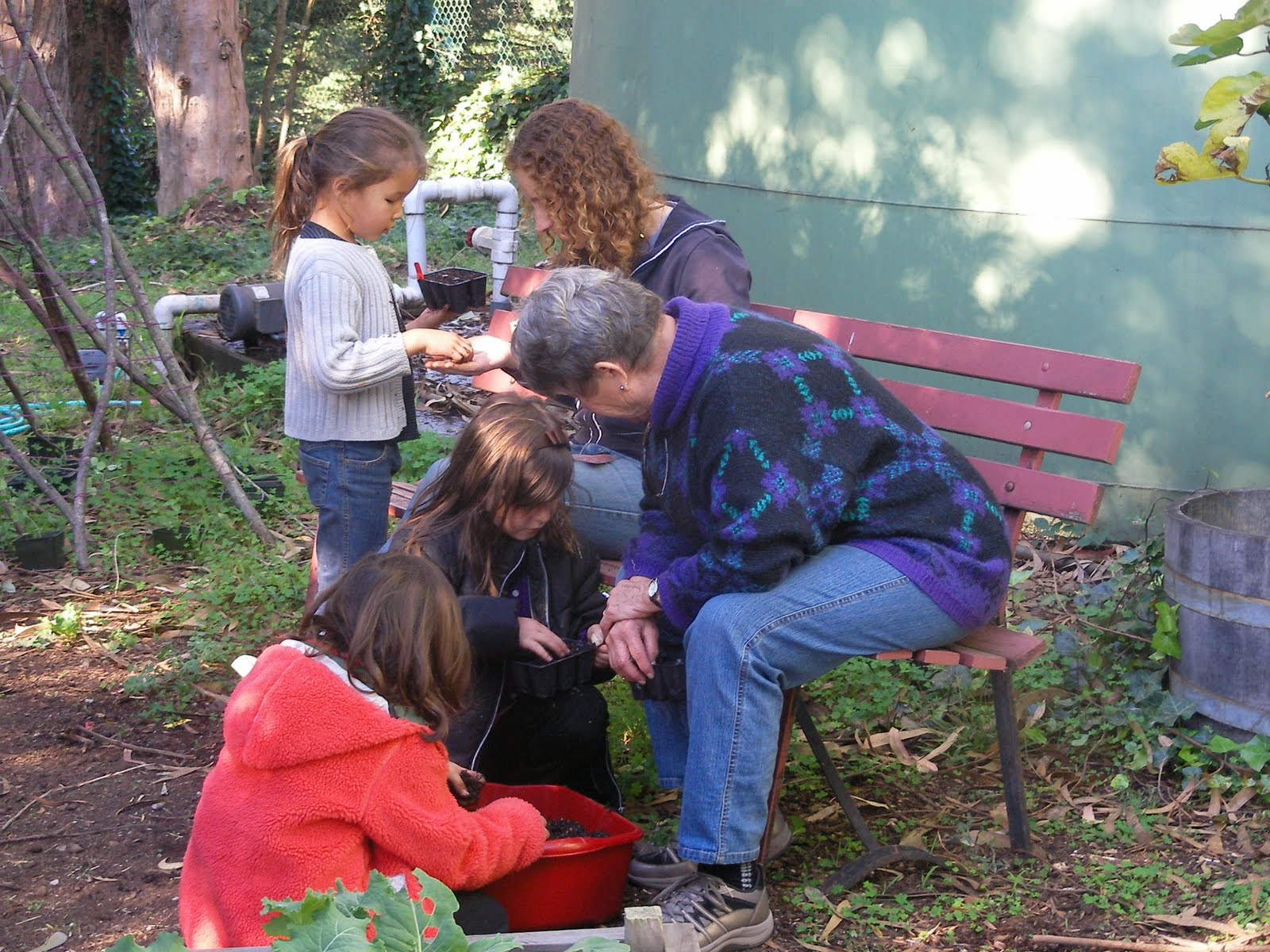
The students participate as well in our new focus. In addition to the usual singing and greeting in the hallways, the first graders are transplanting edibles onto patios, the second graders are installing the expanded herb garden, and the third graders prepare and pass out food to the residents during their lunch service on Wednesdays. The residents love to taste the offerings from the garden (included so far have been tomatoes, apples, salad greens and herbal tea) and thoroughly enjoy conversing with the children.
Spring and Summer Reflections August 30, 2011
Spring and summer in the gardens
Welcome back to school!
The school garden keeps turning up potatoes! Even in late August, in beds I thought had long been cleaned out by eager third grade diggers, I keep finding more and more potatoes waiting under the soil. I harvested several of the darkest purple variety. Their starchy insides were deep purple with clouds of bright white here and there. On another potato note, back in June at St. Anne’s the First Grade finished work on the new three-level terrace near the palm tree. With the help of a few dedicated parents, the children worked for weeks to terrace a small hillside - laying stones, moving soil, and then mulching it with compost. When finished, every first grader planted a variety of fingerling potato. These are small potatoes, shaped long and slender like fingers. Those potato plants went wild over the summer and are now dying back-just in time for the 3rd grade harvest dinner this fall!
Peas are another constant in our San Francisco gardens. They like our cool weather and grow prolifically along a string or chicken wire lattice. We plant mainly the sugar snap variety, the kind where you can pop the whole pod in your mouth, no need to shell them unless you let them sit too long on the vine. We interspersed sweet peas with the edible peas this year for a burst of color and sweet scent. It’s important to build different trellis structures for peas and beans: peas like to grab on to twine or small stems of other sturdy plants with their tendrils. The trellis should have twine or wire running both ways, horizontal and vertical. Beans, on the other hand, don’t have tendrils. Beans like to follow a single piece of twine vertically, as if they’re climbing a fireman’s pole. They attach by twisting their stalk around the vertical support. Lateral wire lines would only get in the way of their spiraling action.
At the end of the school year each kindergarten class put in a tomato plant, complete with a very dramatic, slow-release fish head fertilizer courtesy of Bryan’s in Laurel Village. These tomatoes are doing well. We also planted half a dozen in pots on the patio for St. Anne’s residents to enjoy. The cool spring caused many of my tomato seedlings to develop an illness called blight. Blight is very common in cool, wet weather. Luckily none of them had gone in the ground at this point, so I was able to cull the infected starts. It was actually a helpful way for me to see which varieties were most resistant. The most robust varieties were Stupice, Black Plum, Northern Delight, and Camp Joy. These are all cherry to small in size, the most likely size to ripen in our SF summers.
At Laguna Honda we are witnessing the benefits of greenhouse growing in the hospital’s state of the art greenhouse. The inside is a jungle of tomato forests, cucumber walls, pepper and eggplant tables, and even sprawling watermelon vines. The greenhouse has opened a wonderful world of warm weather vegetable growing to us-a treat for San Francisco. I have never seen a cucumber growing outdoors like this one pictured here!
The students at St. Anne’s had the privilege this past spring to watch a Black Phoebe bird build her straw, feather and mud nest and then proceed to hatch and raise two young. The first graders were the first to discover the hidden nest one rainy day when a small group of them worked on a project in the protected grotto. They heard small peeps and cleverly detected the location. This nest, tucked up in one of the inner folds of the grotto, provided great pleasure for us as we watched the babies grow into fluffy fledglings. Those two babes left the nest before school ended, and I’m happy to report the mother Phoebe went on to lay another egg and raise one more baby in June.
We ended our year in the gardens at St. Anne’s and Laguna Honda with our thank you parties for the residents and staff. At Laguna Honda the high school students helped to wheel out close to twenty residents for an afternoon of animal viewing and snacks. At St. Anne’s, I invited the residents and staff of St. Anne’s and the third grade families who’ve helped so willingly in the garden these four years. We enjoyed food from the garden, garden-themed art by the residents, and the beautiful sounds of Ms. Christofferson playing her harp.
Just before school let out we secured a honeybee swarm for our new hive across the street from St. Anne’s at Tad Kinney’s home (Sam gd 6, Liza gd 5). The swarm originated in the backyard hive of a Noe Valley bee keeper. My daughter and I drove the swarm across town to Tad’s with the bees contained in a swarm box, basically a sealed card board banker’s box with some mesh ventilation holes. Rinat Abastado, our long time beekeeper, installed them with a gentle shake into their new top bar hive. As Rinat and her family moved north this summer to Sebastopol, Karmin Guzder has happily agreed to take over bee keeping for the hive. Ms. Guzder and I visited the hive in late June and were delighted to discover thirteen bars full of beautiful snow white comb containing drone and worker cells, as well as capped honey. The bees are thriving. 
In August, Ms. Guzder and I thought we spied a queen cell on the bottom corner of the comb. Sure enough, days later the bees swarmed and with quick phone calls we were able to find a bee keeper to capture the swarm while it hung in a tree next door to the Kinney’s. That swarm now resides in our Golden Hive at Laguna Honda where they have settled in well despite the foggy weather of late. We feel so lucky to have two hives from the same robust bee family!
I’ve included two photos of the 3rd graders working on their stunning 100 year old reclaimed redwood tool shed they built for the St. Anne’s garden. Thank you to Ms. Christofferson’s class, Chris Gate, Chris Larrance and Todd Oppenheimer for their time on this project.
I want to extend my gratitude to all my 2010-11 garden volunteers and drivers at St. Anne’s and Laguna Honda. There were over 35 of you who gave your time and energy to the Urban Farm and Garden Program and I am deeply grateful. Thank you. Also, a special thanks to our generous host facilities: St. Anne’s and Laguna Honda Hospital. Our school could not offer these programs without these partnerships!
Please contact me if you’d like to garden with us this fall!
31 March 2011
Live Power Community Farm Trip


Last week the third grade received an honor bestowed on them by Gloria and Stephen Decater of Live Power Community Farm in Covelo (Mendocino County), CA (www.livepower.org). The Decaters told the children that in their 27 years of hosting school groups, 10 groups per year, our 3rd grade had experienced the most extreme weather to date. The Decaters congratulated our children on their resilience, strong work ethic, and good cheer throughout it all.
The Third Grade farm trip to Live Power is a transformative capstone on the children’s four years of gardening curriculum. The farm provides them with opportunities to go beyond the work we do at St. Anne’s, particularly in the animal realm. Under the guidance of the three apprentices Becca, Matt, and Kim, the children milked Bess, the dairy cow, sheared one of the ewes, and chased the cows and sheep out to pasture in the morning and into the barn at night. The children gathered eggs and fed the pig, and were in constant play with the two farm dogs, Sophie and Alder.
Throughout the wet and at times snowy weather , the children attended to the daily chores to support the life of the farm. In addition to animal care, the children mucked out stalls, wheeled the manure to the compost yard, built compost piles, split and stacked wood, baked bread, shucked corn and ground it into meal. There were nails to take out of recycled wood, brambles and branches to clear, and dishes to wash.
When we arrived Tuesday in the dry afternoon, the Decaters had prepared the two draft horses, Pete and Laura. After the children pet the horses, Stephen led the 3rd graders in an exciting activity of working together to pull a sled. The children worked in two teams along the wooden yoke, pulling as one to keep the sled moving over the rutted pathway. As the teams gained momentum, other children would jump on the sled, and we’d count how many each team could pull. It was hard work as we adults found out on our turn!
Once we had tried to work as the horses do, Stephen hitched the two draft horses to the yoke and the horses pulled groups of children on the sled back and forth on the lane. The kids loved it and we were all amazed by how effortless the horses made it look. The children learned firsthand the meaning of horsepower and teamwork.
Each night we slept in tents and stirred at night to the hammering of rain or purring of snow on the fly. Our tents withstood the snow and rain pretty well, but it was hard to keep the water from pooling around the doors and sneaking in with the children and all their wet gear. The parents set up elaborate systems to ensure the tents stayed as dry and mud-free as possible!
Debbie Hopkins was our farm chef and provided us with delicious and plentiful meals three times a day. The kids clamored for seconds and thirds and particularly loved her soups and the fresh baked breads with honey. Ms. Christofferson and I are indebted to all of our marvelous and intrepid parent volunteers: Craig Appel, Hugh Molesworth, Chris Larrance, Peter Belanger, Joel Bleskacek, Lesley Fisher, Carrie Leeb and Debbie Hopkins. They were expert campers and loving caregivers.