08 January 2012
Pumpkin Fairy Houses, October 2011
When the First Grade comes to the garden each Friday, they are greeted with a letter from the Queen of Workenwonder. Workenwonder comprises the grounds of St. Anne's.
These letters help connect the children to their roles and responsibilities at the garden. For example, the adventurous tale of Sir Trowel instructed how to properly weed the flower garden paths. Another story, told about an old sow bug, stressed how work can build community and self esteem.
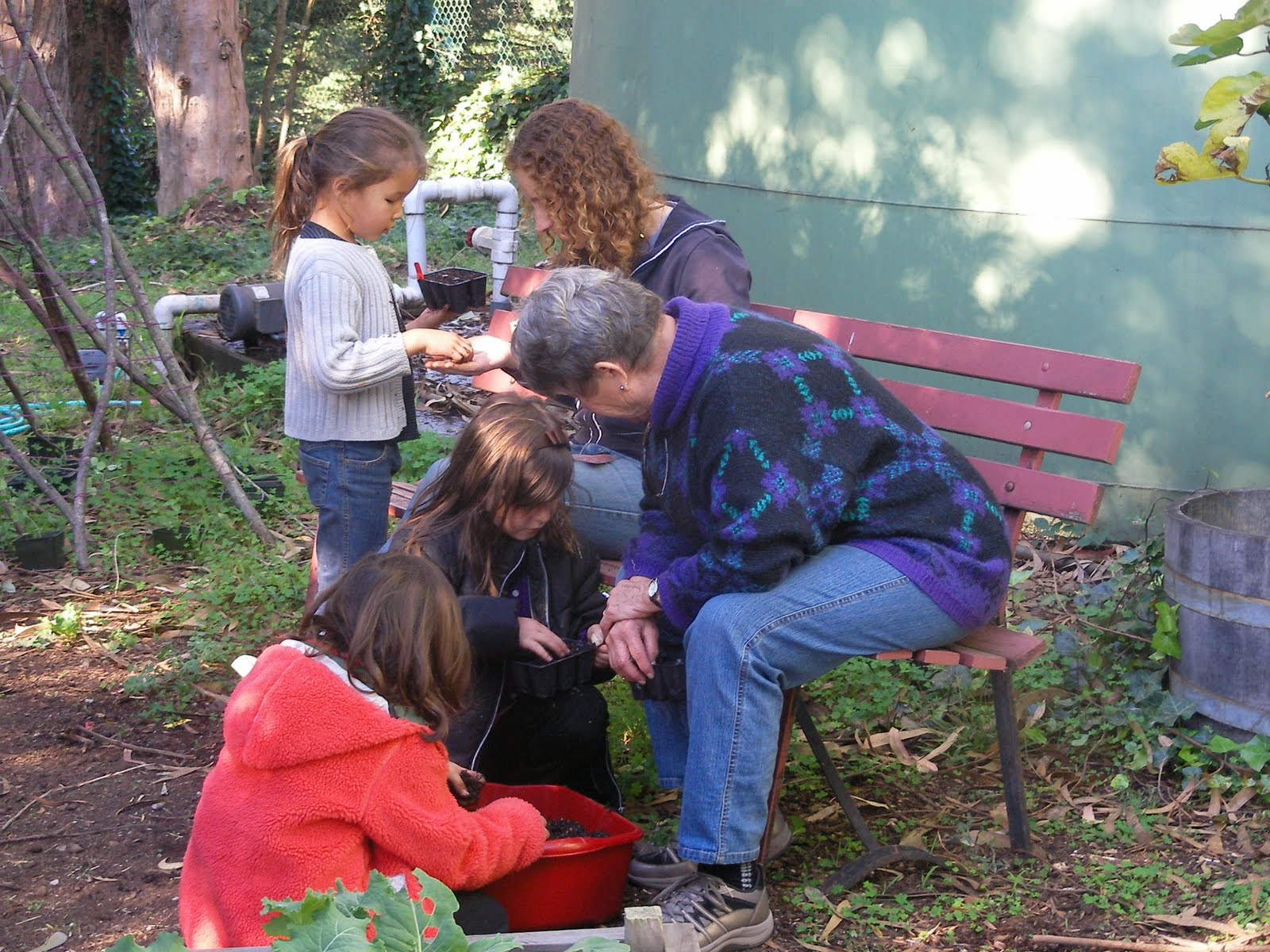
On our visit before Halloween, the Queen invited the children to build pumpkin fairy houses for the garden fairies. You can read her letter below and see the stunning creations the children made.
Dear First Grade,
Today, my first grade workers, we honor our dear frisky friends, the garden fairies. I’m sure you’ve seen them here and there: the flash of color on a hummingbird’s neck, the sparkle of sunlight on a falling water drop, the spectacular green of a new leaf; the fairies abound and the beauty they bring to our garden here in Workenwonder knows no bounds.
Today is the last Friday of October and so it is the day the fairies look forward to all year. For it is the day they move into their freshly decorated pumpkin homes. It’s a tradition here in the Queendom, our gift to the fairies for all the splendor they bring to us each day.
The job of decorating their houses falls to you, first graders. Each group will decorate one pumpkin fairy home to make it comfortable and beautiful for a fairy to move in.
This is a surprise for the fairies, remember dear children. So go about your work quietly and with great focus. I’ve hidden the pumpkins around the garden so the fairies won’t find them until they are ready. Carefully follow your directions and you will discover your pumpkin hidden on our grounds.
When you are finished with your little home, we’ll take a look at all the others, and then, when you turn your backs and head to school, those fairies will delight in unpacking their little suitcases and making your pumpkins their homes.
Enjoy, and serve the fairies well.
Sincerely,
The Queen of Workenwonder
30 December 2011
Intergenerational garden grant 2011
Our grant came as part of a satisfying shared grant making process led by RSF. SF Waldorf School was selected along with six other Bay Area agricultural activist groups to come together and cooperatively allocate $50,000 dollars in grant monies. You can read more about this inspiring process by clicking the article in the sidebar.
In order to begin my studies in horticultural therapy, I first spent time observing the activity therapists at Laguna Honda. For many years Laguna Honda has offered a therapeutic garden program for its residents. The therapists bring gardening activities such as seed selection, propagation and transplanting into the residential neighborhoods. There the residents gather in the common areas and participate in the various activities. Importantly, great effort is made to get the residents outside and into the farm and garden. The new therapeutic garden is first class with its multiple raised beds, friendly farm animals and easily accessed orchards and meadow.
I am also looking into Anthroposophically based residential communities such as Camphill and Fellowship Communities. These communities located around the world emphasize the healing power of work and social cooperation and service. Each of these communities is anchored by a substantial farm, and much of the communities' work revolves around producing food for the animal and human inhabitants. I had the privelege of visiting Camphill California in Soquel , as well as Camphill Copake, NY and the Fellowship Community in Spring Valley, NY this year.
I attended the national conference of the American Horticultural Therapy Association in Asheville, NC this fall as well. The AHTA offers coursework and academic journals and research into the best practices in horticultural therapy. Most of this work focuses the healing possibilities of gardens in institutional settings, such as hospitals, prisons, community centers, and schools.
In addition to these educational pursuits, I have used our grant money to purchase items to better serve the St. Anne's residents. For example, pots and soil so that we can begin planting edibles on patios where all residents can access them; a collection of herbs so that we can begin an herb processing program engaging both students and resident hands, and greater quantities of seeds so that we can more substantially share our produce with the residents and staff.
This January I plan to begin individual visits with the most infirm residents using herbs as a gateway to sensory stimulation and conversation about favorite foods, recipes and memories surrounding related scents and tastes.
The students participate as well in our new focus. In addition to the usual singing and greeting in the hallways, the first graders are transplanting edibles onto patios, the second graders are installing the expanded herb garden, and the third graders prepare and pass out food to the residents during their lunch service on Wednesdays. The residents love to taste the offerings from the garden (included so far have been tomatoes, apples, salad greens and herbal tea) and thoroughly enjoy conversing with the children.
Spring and Summer Reflections August 30, 2011
Spring and summer in the gardens
Welcome back to school!
The school garden keeps turning up potatoes! Even in late August, in beds I thought had long been cleaned out by eager third grade diggers, I keep finding more and more potatoes waiting under the soil. I harvested several of the darkest purple variety. Their starchy insides were deep purple with clouds of bright white here and there. On another potato note, back in June at St. Anne’s the First Grade finished work on the new three-level terrace near the palm tree. With the help of a few dedicated parents, the children worked for weeks to terrace a small hillside - laying stones, moving soil, and then mulching it with compost. When finished, every first grader planted a variety of fingerling potato. These are small potatoes, shaped long and slender like fingers. Those potato plants went wild over the summer and are now dying back-just in time for the 3rd grade harvest dinner this fall!
Peas are another constant in our San Francisco gardens. They like our cool weather and grow prolifically along a string or chicken wire lattice. We plant mainly the sugar snap variety, the kind where you can pop the whole pod in your mouth, no need to shell them unless you let them sit too long on the vine. We interspersed sweet peas with the edible peas this year for a burst of color and sweet scent. It’s important to build different trellis structures for peas and beans: peas like to grab on to twine or small stems of other sturdy plants with their tendrils. The trellis should have twine or wire running both ways, horizontal and vertical. Beans, on the other hand, don’t have tendrils. Beans like to follow a single piece of twine vertically, as if they’re climbing a fireman’s pole. They attach by twisting their stalk around the vertical support. Lateral wire lines would only get in the way of their spiraling action.
At the end of the school year each kindergarten class put in a tomato plant, complete with a very dramatic, slow-release fish head fertilizer courtesy of Bryan’s in Laurel Village. These tomatoes are doing well. We also planted half a dozen in pots on the patio for St. Anne’s residents to enjoy. The cool spring caused many of my tomato seedlings to develop an illness called blight. Blight is very common in cool, wet weather. Luckily none of them had gone in the ground at this point, so I was able to cull the infected starts. It was actually a helpful way for me to see which varieties were most resistant. The most robust varieties were Stupice, Black Plum, Northern Delight, and Camp Joy. These are all cherry to small in size, the most likely size to ripen in our SF summers.
At Laguna Honda we are witnessing the benefits of greenhouse growing in the hospital’s state of the art greenhouse. The inside is a jungle of tomato forests, cucumber walls, pepper and eggplant tables, and even sprawling watermelon vines. The greenhouse has opened a wonderful world of warm weather vegetable growing to us-a treat for San Francisco. I have never seen a cucumber growing outdoors like this one pictured here!
The students at St. Anne’s had the privilege this past spring to watch a Black Phoebe bird build her straw, feather and mud nest and then proceed to hatch and raise two young. The first graders were the first to discover the hidden nest one rainy day when a small group of them worked on a project in the protected grotto. They heard small peeps and cleverly detected the location. This nest, tucked up in one of the inner folds of the grotto, provided great pleasure for us as we watched the babies grow into fluffy fledglings. Those two babes left the nest before school ended, and I’m happy to report the mother Phoebe went on to lay another egg and raise one more baby in June.
We ended our year in the gardens at St. Anne’s and Laguna Honda with our thank you parties for the residents and staff. At Laguna Honda the high school students helped to wheel out close to twenty residents for an afternoon of animal viewing and snacks. At St. Anne’s, I invited the residents and staff of St. Anne’s and the third grade families who’ve helped so willingly in the garden these four years. We enjoyed food from the garden, garden-themed art by the residents, and the beautiful sounds of Ms. Christofferson playing her harp.
Just before school let out we secured a honeybee swarm for our new hive across the street from St. Anne’s at Tad Kinney’s home (Sam gd 6, Liza gd 5). The swarm originated in the backyard hive of a Noe Valley bee keeper. My daughter and I drove the swarm across town to Tad’s with the bees contained in a swarm box, basically a sealed card board banker’s box with some mesh ventilation holes. Rinat Abastado, our long time beekeeper, installed them with a gentle shake into their new top bar hive. As Rinat and her family moved north this summer to Sebastopol, Karmin Guzder has happily agreed to take over bee keeping for the hive. Ms. Guzder and I visited the hive in late June and were delighted to discover thirteen bars full of beautiful snow white comb containing drone and worker cells, as well as capped honey. The bees are thriving. 
In August, Ms. Guzder and I thought we spied a queen cell on the bottom corner of the comb. Sure enough, days later the bees swarmed and with quick phone calls we were able to find a bee keeper to capture the swarm while it hung in a tree next door to the Kinney’s. That swarm now resides in our Golden Hive at Laguna Honda where they have settled in well despite the foggy weather of late. We feel so lucky to have two hives from the same robust bee family!
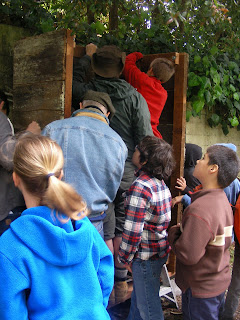
I’ve included two photos of the 3rd graders working on their stunning 100 year old reclaimed redwood tool shed they built for the St. Anne’s garden. Thank you to Ms. Christofferson’s class, Chris Gate, Chris Larrance and Todd Oppenheimer for their time on this project.
I want to extend my gratitude to all my 2010-11 garden volunteers and drivers at St. Anne’s and Laguna Honda. There were over 35 of you who gave your time and energy to the Urban Farm and Garden Program and I am deeply grateful. Thank you. Also, a special thanks to our generous host facilities: St. Anne’s and Laguna Honda Hospital. Our school could not offer these programs without these partnerships!
Please contact me if you’d like to garden with us this fall!
31 March 2011
Live Power Community Farm Trip


Last week the third grade received an honor bestowed on them by Gloria and Stephen Decater of Live Power Community Farm in Covelo (Mendocino County), CA (www.livepower.org). The Decaters told the children that in their 27 years of hosting school groups, 10 groups per year, our 3rd grade had experienced the most extreme weather to date. The Decaters congratulated our children on their resilience, strong work ethic, and good cheer throughout it all.
The Third Grade farm trip to Live Power is a transformative capstone on the children’s four years of gardening curriculum. The farm provides them with opportunities to go beyond the work we do at St. Anne’s, particularly in the animal realm. Under the guidance of the three apprentices Becca, Matt, and Kim, the children milked Bess, the dairy cow, sheared one of the ewes, and chased the cows and sheep out to pasture in the morning and into the barn at night. The children gathered eggs and fed the pig, and were in constant play with the two farm dogs, Sophie and Alder.
Throughout the wet and at times snowy weather , the children attended to the daily chores to support the life of the farm. In addition to animal care, the children mucked out stalls, wheeled the manure to the compost yard, built compost piles, split and stacked wood, baked bread, shucked corn and ground it into meal. There were nails to take out of recycled wood, brambles and branches to clear, and dishes to wash.
When we arrived Tuesday in the dry afternoon, the Decaters had prepared the two draft horses, Pete and Laura. After the children pet the horses, Stephen led the 3rd graders in an exciting activity of working together to pull a sled. The children worked in two teams along the wooden yoke, pulling as one to keep the sled moving over the rutted pathway. As the teams gained momentum, other children would jump on the sled, and we’d count how many each team could pull. It was hard work as we adults found out on our turn!
Once we had tried to work as the horses do, Stephen hitched the two draft horses to the yoke and the horses pulled groups of children on the sled back and forth on the lane. The kids loved it and we were all amazed by how effortless the horses made it look. The children learned firsthand the meaning of horsepower and teamwork.
Each night we slept in tents and stirred at night to the hammering of rain or purring of snow on the fly. Our tents withstood the snow and rain pretty well, but it was hard to keep the water from pooling around the doors and sneaking in with the children and all their wet gear. The parents set up elaborate systems to ensure the tents stayed as dry and mud-free as possible!
Debbie Hopkins was our farm chef and provided us with delicious and plentiful meals three times a day. The kids clamored for seconds and thirds and particularly loved her soups and the fresh baked breads with honey. Ms. Christofferson and I are indebted to all of our marvelous and intrepid parent volunteers: Craig Appel, Hugh Molesworth, Chris Larrance, Peter Belanger, Joel Bleskacek, Lesley Fisher, Carrie Leeb and Debbie Hopkins. They were expert campers and loving caregivers.
30 November 2010
November in the Gardens

November in the gardens
The second grade Snails planted barley, wheat, and rye recently. This grain will go into their third grade harvest dinner bread next fall! Yes, grain takes a while to grow. We grow winter varieties that sprout now in the late fall and then stand still for a while in the deepest part of winter. Then, come spring, the shoots shoot up and by April seed heads are forming. The children who are around in mid-summer will come to harvest the grain. Then, just as we did with the current third grade, next fall the now second grade children will thresh, winnow and grind it into flour. To protect our seeds from the hungry birds, K2 will build a scarecrow this week and install it next to the grain bed.
We have one lovely sunflower still blooming in the garden, but nearly all the other summer crops are finished. This week we’ll remove the beans and collect more seeds from the older sunflower heads. We have garlic growing and several brassica varieties. Brassica are cabbage and mustard family plants, such as broccoli, cauliflower, and Brussels sprouts. We need to get more lettuces going as well. Lettuce can be started in San Francisco year round.
The children are enjoying our gigantic leaf pile in the Tower Garden. We’ve been raking eucalyptus leaves all fall, and now we reap the benefit of jumping and burying ourselves in them. The second grade played a spontaneous rendition of “Old Roger is Dead” while burying their friends in the pile. Also in the Tower Garden the children continue to turn the beautifully large compost piles to speed up the piles’ maturation.
Have you noticed the wild onions growing around town? They are just now sending up their first green, ridged leaves. All of the plant is edible. The leaves are like scallions and can be chopped up for salad or stir fries. The bulbs can be cooked as you would a pearl onion. If you notice your gardener coming home with onion breath, this is why!
The animals are settled into their new home at Laguna Honda. The hair sheep and goats are friendly and line up for petting. Their bleating noises keep us company as we work in the gardens there. It is wonderful to have this important animal complement to our garden. A biodynamic garden relies upon the input of on-farm animal fertility (manure). A successful biodynamic farming system is a closed, self-supporting and even enhancing loop: the farm grows the food for all its animals and spreads the compost generated from their manure back onto the land. Happily we can now create that cycle at Laguna Honda.
I had the pleasure of attending a conference in early November located in East Troy, Wisconsin. This was a gathering of farm-based Waldorf educators. Garden teachers came from all over the U.S. to share ideas and learn from an active farm-school community there. Our SFWS program resembles the Chicago Waldorf School’s garden program in that we two urban schools must make use of available city land for our work. They garden on vacant lots and now within a community garden. Just as our programs include our residential host communities, theirs works closely with immigrant populations in Chicago. In East Troy we observed a farm school where there were groups of children building a fence, others clearing manure, and still another group cooking pork chops and apple crisp in the house for the group lunch. It was very inspiring to see the children busy at these important farm chores, especially in 40 degree weather!
31 October 2010
October in the gardens
Oh the late summer of
The flowers have done surprisingly well this year, despite the cool summer. We are now enjoying the process of saving seeds from our annuals. The edible chrysanthemums are particularly satisfying to harvest, a big seed head full of little rectangular seeds that jump into the children’s palms. We also have a wonderful collection of sunflower seed heads. We planted many sizes and colors this year and these flowers provide a perfect example of pollination. Did you know that a sunflower is actually a “face” comprised of 100s of tiny individual flowers? In order for seeds to form, each seed’s flower must get pollinated. It is fascinating for the children to see that within one sunflower head, perhaps only 50% of the husks actually contain true seeds. In addition to saving them for next year, we also enjoy cracking the shells open with our teeth and eating the seeds inside!
The first grade continues to enjoy a weekly chapter of our Adventure story. As a reminder, Adventure is the bee that escaped from our hive at the Kinney’s the night Rinat Abastado and I moved it to Laguna Honda. Adventure is alive and well in our garden at
The third grade is threshing, winnowing and grinding the barley, rye and wheat they planted last fall. The children enjoy these processes and cherish the small drawer of flour that comes from all that manual grinding. Each week’s flour goes into the baked goods the third graders are preparing for their harvest dinner. Today’s group of Weavers was particularly knowledgeable thanks to their recent field trip to the Bale Grist Mill in
We have good news from Laguna Honda. The farm animals will move into their home next to the garden the first week of November. And better still, the residents will move into their new buildings on December 7 and 8. Please contact Mitch Mitchell or me if you would like to volunteer to help move the residents on one of these two days. It will be a large and joyous undertaking. As soon as the residents are settled in, they will start taking part in the daily activities of the garden.
At Laguna Honda Dr. Burket, Mr. Prado and the ninth graders started three large compost piles. The beans are sky high and our pumpkins are ripening. The ninth graders also planted garlic, radishes, and greens. The bees appear to be very happy in their meadow home.
Here is our latest recipe from the first grade and K3:
Fresh potatoes (ideally small ones, like fingerlings)
Boil until just tender and the skin is gently cracked open
Add butter and salt